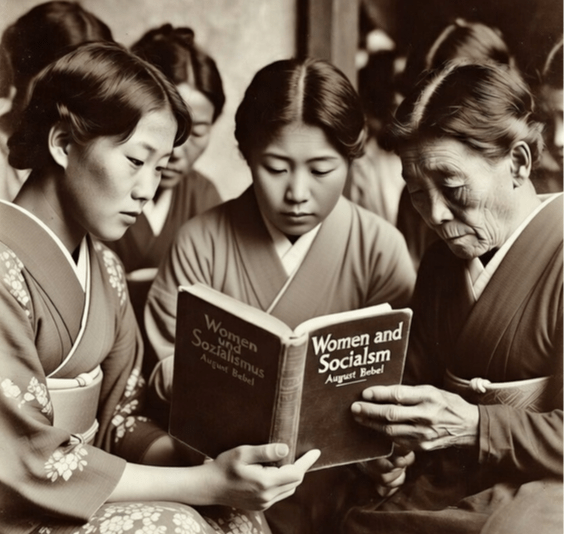
The following piece translated from Japanese was written by Kikue Yamakawa. She wrote it as a Foreword for a 1919 Japanese translation of the first part of August Bebel’s Woman and Socialism. This translation was done by Masao Murakami, who was then a student at Keio University in Tokyo. Yamakawa was a prominent prewar Japanese feminist theorist. The publisher of the 1919 translation, Mita Shobō, invited Yamakawa, who was gaining prominence as a female critic at the time, to write the Foreword.
Although small parts of Bebel’s Woman and Socialism had been translated and discussed in several Japanese newspapers and magazines before 1919, this was the first time a major translation of the work was published as a book. In this book, Murakami indicated his intention to translate subsequent parts, but this promise was never realized because he soon distanced himself from Marxism. Four years later, in 1923, Yamakawa published a complete translation of Bebel’s Woman and Socialism through Ars Publishing, which was the first complete Japanese translation of the work.
In the history of mankind, the first labourer was a woman; so, too, was woman the first plundered.
The primordial division of labour was a biological one; primarily, the division of the sexes. So long as this division represented a mere biological arrangement between the two sexes, it served to guarantee the welfare and progress of human society. The woman-centredness of societies of that era shows this division of labour, based on biological difference between the sexes, not to necessarily entail the subjugation or mastery of woman.
However, once a socio-economic division of labour was grafted onto this biological difference, human social existence underwent total transformation. An economic division of labour developed most starkly between woman and man. Thus did woman become the first conquered in human history—she was the first slave.
Many slaves were freed. Yet that most ancient of slaves, known as woman, remains unfree. Even among the so-called civilized men of today—among those who speak calmly about war and poison gas, and who, following peace dinners, pronounce unceasingly upon their new-model rifles—there is none who does not count slavery a shame. Nevertheless, those who do not marvel at our modern life, which rests upon this very system of sexual slavery, are few in number.
On one hand, even the slaves who were said to have been freed have not necessarily attained true freedom. That which awaited the slave released from their iron chains was the chains of wages. Nay, they were liberated from their iron chains for the very purpose of becoming ‘freely’ bound by the chains of wages. On the other hand, it cannot be said that woman has been wholly denied liberation. Demands for woman’s economic independence and suffrage must, in short, be regarded as a species of demand for emancipation from sexual slavery.
Some women surely have, through economic independence, been freed from the fetters of the home. But they have confronted the “Tragedy of Woman’s Emancipation”. Those women released from the chains of the household were compelled to be bound by the chains of wages.
Thus, the woman question necessarily became fused with the labour question. Economic independence of women, suffrage, and campaigns for maternity protection each, no doubt, address a dimension of the woman question within their respective domains. However, at least for that dimension of the woman question part of the general labour question, neither campaigns for female jobs, nor suffrage, nor maternity protection offer any means of redress. So, until a resolution is found for this part, it cannot be said that the woman question is properly understood or addressed.
In this respect, August Bebel’s Women and Socialism stands above many if not all treatises on the woman question. That his world-renowned masterpiece is now available to the men and women of Japan through translation by Mr. Masao Murakami is a matter of my profoundest pleasure. I harbor not a shadow of doubt that this most timely publication shall render a great service toward the awakening of the women of Japan.
Kikue Yamakawa, 24 July 1919
 ポルノ・買春問題研究会|国際情報サイト