This article describes recent developments in Japan regarding prostitution in their historical context, which includes feminist criticism of male demand for the prostitution of women for the past one hundred years.
Japan’s first female prime minister, Sanae Takaichi, took office on 21 October 2025, and, just three weeks later, on 11 November, directed the country’s justice minister to begin deliberating whether or not to penalise sex buyers. Since the enactment of the Prostitution Prevention Law in 1956, prostitution has been officially condemned in Japan as a violation of human dignity, and becoming a customer of the sex industry banned, if not punished. So, deliberations are underway to decide whether Japan will newly join those countries around the world that punish sex buyers as an initiative of women’s rights. For Japan, this would involve, among other amendments, adding penalties for sex buying to its Prostitution Prevention Law.
Before taking this action, Prime Minister Takaichi in the parliament had called the “prostitution of Japanese women by foreign tourists [that] is rampant in Tokyo, including Kabukicho” a “very serious problem.” But the drive to punish sex-buyers arose not just out of concern for international reputation. In the same parliamentary session, she also spoke of the need to shut off the financing of organised crime that comes from payments made by sex buyers. This is a significant motivation: the same concern about organised crime funding prompted wide-ranging legislative amendments in April 2025 that aimed to crush the commercial activities of host clubs.
Japan’s justice ministry convened a panel of experts to deliberate legislative change, which is now consulting with stakeholders. Among these are sex industry representatives, and it is these prostitution businessmen, rather than ‘sex work’ ideological lobbyists, who fight the hardest to protect sex-buyers in Japan. In this respect, history repeats itself: sex industry businessmen waged the same fight in Japan after the end of the war to protect the industry’s income stream. They did so with only partial success: as mentioned, sex buying was banned in Japan’s 1956 Law but awarded no penalty.
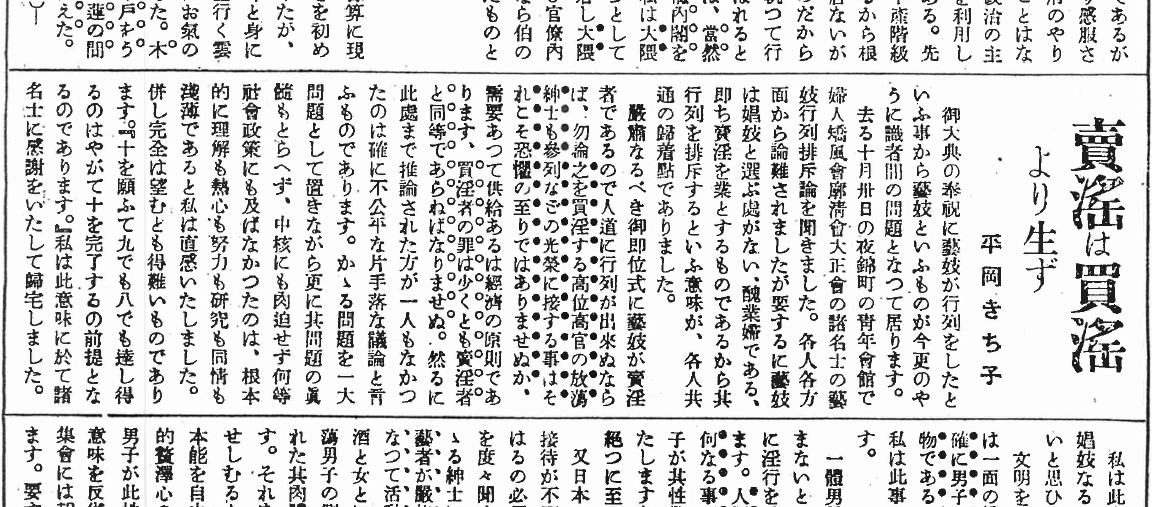
Without sex industry protection, sex buyers in Japan find themselves in a chilly environment. Feminist criticism of their behavior goes back to the turn of the 20th century, and pulls few punches. Kichiko Hiraoka (平岡喜知子) in 1916,* for example, wrote an abolitionist article in the progressive magazine Kouzui Igo [Après le Déluge: After the Flood]. She suggested that economic laws of supply and demand meant that the behavior of sex industry customers was responsible for generating populations of prostituted women, and so suppressing these men’s “irresponsible sexual debauchery” would see their disappearance. Hiraoka’s attendance at a Japan Christian Women’s Organization (Kyofukai) meeting in 1915 that had resolved to condemn the participation of geisha in a large-scale celebration event for the Taisho emperor prompted her comment. While she supported the resolution, she left the meeting wondering why it wasn’t “distinguished gentlemen” attending the event condemned. It was they, after all, whose sexual demand, loosened by alcohol, turned geisha from artists into prostitutes.
* Kichiko Hiraoka, “Bai’in wa kai’in yori shozuru [Sex selling arises from sex buying],” Kouzui Igo, Vol. 1, 1 January 1916, p. 32.
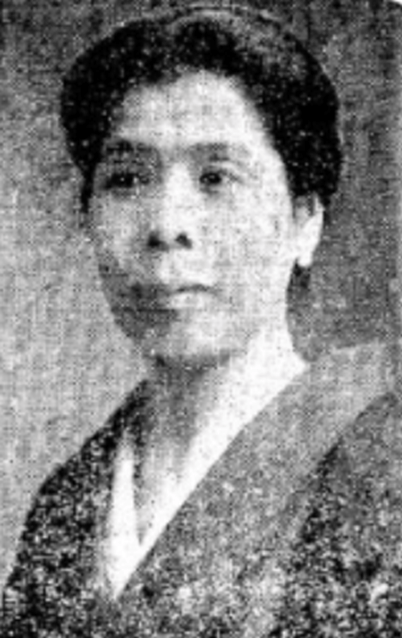
Hiraoka, as the Christian widow of a high-ranking Japanese army general, created a charity organization called Kougaku-kai (向学会) in 1919 that assisted foreign students from China, Taiwan, and the Korean peninsula. Her organisation enjoyed the patronage of Japan’s highest-ranked politicians, including Tsuyoshi Inukai, Yukio Ozaki, and Takejiro Tokunami. She travelled all over Japan and even visited countries overseas, such as China and Taiwan, to raise money for its operations, and spoke in venues to audiences of hundreds. While she lived in the upper echelons of Japanese society, her solution to the problem of prostitution was to call on elite men to disavow their sexual irresponsibility and debauchery, and to call on Japan’s social and academic elite—doctors, psychologists, educators, and social policy experts—to establish research groups to undertake studies aimed at abolishing prostitution. Through this model behavior, they would lead all men in the country towards reform.
While Prime Minister Takaichi is an historically different figure from Hiraoka, she too recognises sex buyers as a social problem. She came to power in a country with a record of feminist criticism of male sexuality, mostly from before the war. That criticism has recently revived, and centers on both foreign men visiting Japan as sex tourists as well as male citizens, including members of the male ruling elite who continue to exhibit “irresponsible sexual debauchery.” As was the case in the 1950s, the historical defeat of these men is obstructed by their sex industry defenders. But defeating them would see Takaichi join not only Hiraoka but also Kajiko Yajima, Ochimi Kubushiro, Kikue Yamakawa, Ichiko Kamichika, Michiko Fujiwara, Akiko Yosano, Raicho Hiratsuka, Waka Yamada, Yayoi Yoshioka, Mumeo Oku, and Fusae Ichikawa in the annals of Japanese history that records a proud feminist tradition of dismantling men’s sexual entitlements.

